
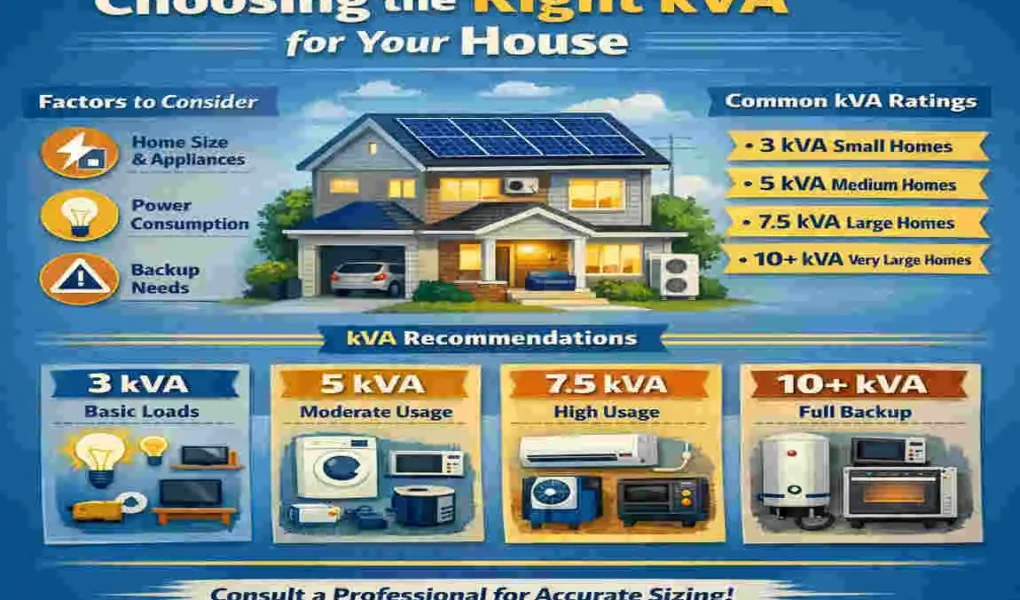
If you are trying to figure out how much kVA is required for a house, you are already asking the right question.
The answer matters because the right power capacity keeps your home running smoothly. It helps you avoid overloads, sudden shutdowns, and wasted money on a system that is too big or too small.
In simple words, kVA tells you how much electrical load a house can handle. If the capacity is too low, your appliances may trip the system. If it is too high, you may spend more than you need to.
What Is kVA?
Definition of kVA
kVA stands for kilovolt-ampere. It is a unit used to measure electrical power capacity.
For a homeowner, you can think of it as the size of the power supply your house needs. It shows how much load your electrical system can support at one time.
If your house has many appliances, larger rooms, or heavy-duty items like air conditioners and water heaters, you will need a higher kVA rating.
Difference Between kVA and kW
People often mix up kVA and kW, but they are not the same.
- kVA is the total power supplied
- kW is the actual power used by appliances
The difference comes from something called power factor. In simple terms, not all electricity supplied is used perfectly by appliances. Some is lost in the process.
A common rule is:
kW = kVA × power factor
For many homes, the power factor is around 0.8. So if a generator is rated at 10 kVA, it may deliver about 8 kW of usable power.
Why Homeowners Should Understand kVA
Knowing your kVA requirement helps you in several ways:
- Prevents overloads
- Improves electrical safety
- Helps you choose the right generator
- Avoids unnecessary spending
If you understand your home’s power needs, you can make smarter decisions and protect your appliances.
How Much kVA Is Required for a House?
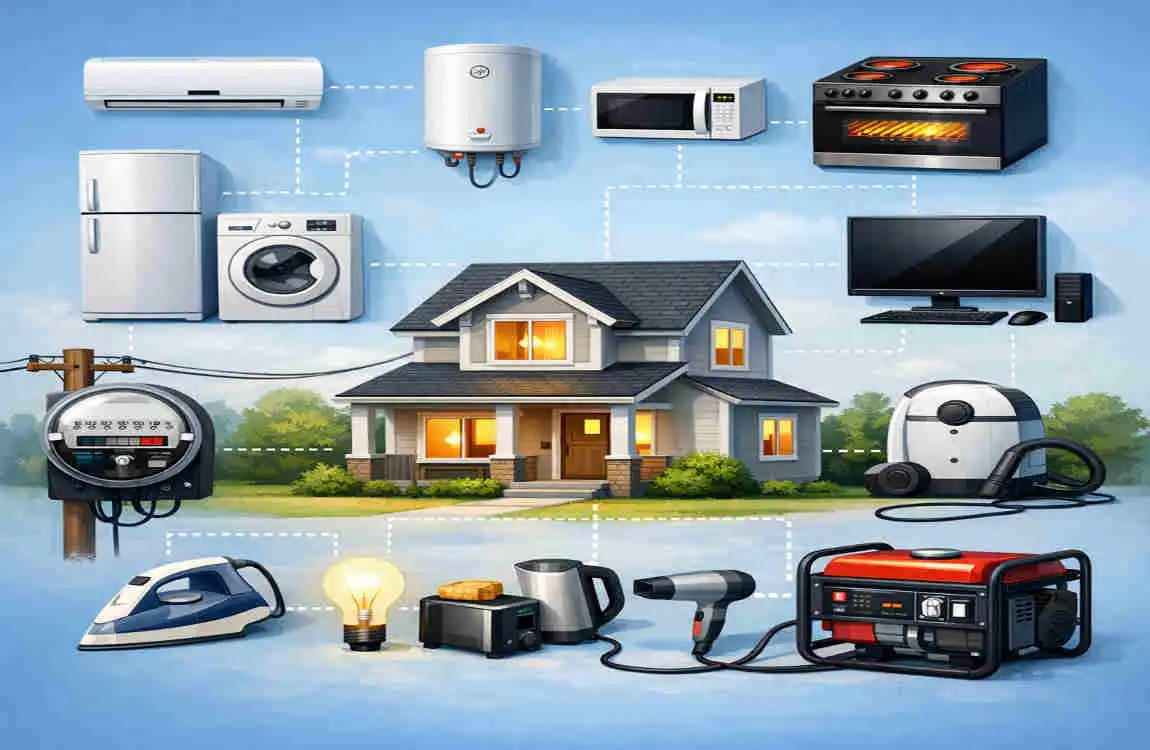
Average kVA Requirement by Home Size
The right kVA depends on home size and the number of appliances. Here is a simple guide:
House Size Recommended kVA
1 Bedroom 3–5 kVA
2 Bedroom 5–7.5 kVA
3 Bedroom 7.5–10 kVA
4 Bedroom 10–15 kVA
Large Luxury Home 15–25+ kVA
This table is a general guide. Your actual need may be higher or lower depending on how much electricity you use.
Factors That Affect kVA Requirements
Several things affect how much kVA your house needs:
- Number of rooms
- Air conditioners
- Water heaters
- Kitchen appliances
- Electric vehicle charger
- Home office equipment
A small house with many appliances may need more power than a larger house with very few devices. That is why appliance load matters more than house size alone.
How to Calculate the Required kVA for a House
Step 1 – List All Electrical Appliances
Start by writing down everything that uses electricity in your home.
Include items like:
- Lights
- Fans
- Refrigerator
- Television
- Microwave
- Washing machine
- Air conditioner
- Water pump
- Kettle
- Laptop or desktop computer
Try to include both regular appliances and high-power appliances.
Step 2 – Calculate Total Wattage
Next, find the wattage of each appliance. Wattage tells you how much power each item uses.
For example:
- LED bulb = 10 W
- Ceiling fan = 75 W
- Refrigerator = 250 W
- Microwave = 1200 W
- Air conditioner = 1500–2500 W
Add all the wattage values together to find your total load.
For example, if your house uses:
- 10 LED bulbs = 100 W
- 5 fans = 375 W
- 1 refrigerator = 250 W
- 1 microwave = 1200 W
- 1 AC = 2000 W
Your total wattage is 3925 W.
Step 3 – Convert Watts to kVA
To convert watts into kVA, use this formula:
kVA = Watts ÷ (1000 × power factor)
If the power factor is 0.8, then:
kVA = 3925 ÷ (1000 × 0.8)
kVA = 3925 ÷ 800
kVA = 4.9 kVA
So, in this example, a 5 kVA system would be enough.
Step 4 – Add a Safety Margin
Always add some extra capacity.
A safety margin helps when:
- More appliances are added later
- Multiple devices run at the same time
- Some appliances need extra starting power
A good idea is to add 20% to 25% extra capacity. This gives your home more flexibility and reduces the risk of overload.
Typical Power Consumption of Household Appliances
Common Appliance Power Ratings
Here is a quick table to help you estimate load more easily:
Appliance Average Watts
LED Bulb 10 W
Ceiling Fan 75 W
Refrigerator 250 W
Microwave 1200 W
Electric Kettle 2000 W
Washing Machine 800 W
Air Conditioner 1500–2500 W
Water Pump 750–1500 W
These are average values. Your actual appliance wattage may be a little different depending on the model and brand.
Why Appliance Wattage Matters
Some appliances use very little power. Others use a lot.
For example, lights and fans usually do not create a big load. But an air conditioner, kettle, or water heater can raise your total power demand very quickly.
That is why people often think their home needs a small generator, but when they add everything up, they realize they need much more.
Recommended Generator Size for Different Homes
Small Homes
A small home with basic appliances usually needs 3 to 5 kVA.
This is enough for:
- Lights
- Fans
- TV
- Fridge
- A few small devices
If you want to power an air conditioner or multiple kitchen appliances, you may need more.
Medium-Sized Homes
A medium home often needs 5 to 10 kVA.
This works well for:
- 2 to 3 bedrooms
- Multiple fans and lights
- Fridge
- TV
- Washing machine
- One air conditioner
This range is common for average families.
Large Family Homes
A larger family home may need 10 to 15 kVA or more.
This size is better when you have:
- Several air conditioners
- Water heaters
- Pump systems
- More lighting and outlets
- Heavy daily appliance use
Luxury Homes with High Electrical Demand
Luxury homes can need 15 to 25+ kVA.
These homes may include:
- Several AC units
- EV charging
- Large kitchen equipment
- Security systems
- Home offices
- Pool pumps or extra water systems
If your home has many high-load items, it is safer to choose a larger capacity.
Single-Phase vs. Three-Phase Power
Single-Phase Power
Single-phase power is common in many homes. It is usually enough for small and medium houses.
It works well for normal home use such as:
- Lighting
- Fans
- TV
- Fridge
- Basic kitchen appliances
It is simpler and often cheaper to install.
Three-Phase Power
Three-phase power is designed for heavier electrical loads.
It is a better choice when you have:
- Larger homes
- Multiple air conditioners
- Electric vehicle chargers
- Heavy appliances
- Higher total demand
Which One Is Best for Residential Use?
For most homes, single-phase power is enough.
But if your home has a very high load or if you plan to add more appliances in the future, three-phase power may be the better option.
Common Mistakes When Choosing House kVA
Buying an Undersized Generator
This is one of the biggest mistakes.
If the generator is too small, it may:
- Trip often
- Struggle with appliance startup
- Wear out faster
- Fail to support your home properly
Overspending on Excess Capacity
Some people buy a very large generator just to be safe.
That can lead to:
- Higher purchase cost
- More fuel use
- More maintenance cost
- Unnecessary spending
The goal is balance, not just size.
Ignoring Starting Power Requirements
Some appliances need extra power when they first start.
This is called starting surge.
Air conditioners, pumps, and refrigerators often need more power for a short time when turning on. If you ignore this, your system may fail even if the running load looks fine.
Forgetting Future Expansion
Think ahead.
If you plan to add:
- Another AC
- An EV charger
- More rooms
- A home office
then choose a slightly larger kVA now. It can save you from another upgrade later.
Benefits of Choosing the Right kVA
Better Energy Efficiency
When your kVA matches your home’s needs, your system works more efficiently.
You avoid waste and keep power use under control.
Longer Equipment Life
A well-sized system protects your appliances.
It reduces stress on:
- Fans
- Compressors
- Pumps
- Fridges
- Electronics
That means your devices may last longer.
Reduced Power Interruptions
The right kVA helps reduce:
- Breaker trips
- Voltage drops
- Sudden shutdowns
This gives you a more stable home power supply.
Improved Home Safety
Electrical overloads can be risky.
Choosing the correct capacity helps lower the chance of:
- Overheating
- Short circuits
- Damaged wiring
- Fire hazards
Safety should always come first.
Energy-Saving Tips to Reduce Power Demand
Use Energy-Efficient Appliances
Modern appliances often use less electricity.
If you replace old items with energy-efficient ones, your total load may drop.
Replace Old Lighting with LEDs
LED lights use far less power than old bulbs.
They are bright, long-lasting, and easy to use across the home.
Manage Peak Electrical Loads
Try not to run many heavy appliances at the same time.
For example, avoid using the microwave, kettle, and washing machine all together if your system is small.
Install Smart Energy Monitoring Devices
These devices help you see how much electricity your home uses.
Once you know your load pattern, it becomes easier to manage usage and avoid overload.
Signs Your House Needs a Higher kVA Capacity
Frequent Breaker Trips
If your breaker keeps tripping, your luxury home may be drawing too much power.
That is a clear warning sign.
Lights Dimming During Appliance Use
If lights dim when the AC or pump starts, your system may be underpowered.
This usually means your house needs more capacity.
Generator Overloading
If your generator sounds strained, shuts down, or cannot support all appliances, it may be too small.
Increasing Household Electricity Needs
As families grow, power demand also grows.
If you have added more devices over time, your old kVA rating may no longer be enough.
Cost Considerations When Upgrading House Power Capacity
Generator Costs
A higher kVA generator usually costs more.
Before buying, compare the upfront price with your real power needs.
Electrical Panel Upgrades
Sometimes you also need to upgrade the electrical panel, wiring, or breaker system.
This adds to the total cost.
Installation Charges
Professional installation is important for safety.
The price may vary depending on the size of the system and local labor costs.
Maintenance Expenses
Larger systems can also cost more to maintain.
You may need regular servicing, fuel checks, and occasional part replacement.
Frequently Asked Questions
How much kVA is required for a normal house?
Most average homes need 5 to 10 kVA, depending on the number of appliances and total electricity use.
Is a 5 kVA generator enough for a house?
Yes, a 5 kVA generator can be enough for a small home with basic appliances.
What size generator is recommended for a 3-bedroom house?
A 7.5 to 10 kVA generator is usually a good choice for a standard 3-bedroom home.
| Factor | Details |
|---|---|
| What is kVA? | kVA (Kilovolt-Ampere) measures the apparent power capacity of a generator or electrical system. |
| Small House (1–2 Bedrooms) | 3–5 kVA is usually enough for lights, fans, TV, refrigerator, and a few small appliances. |
| Medium House (3–4 Bedrooms) | 5–10 kVA supports air conditioners, washing machines, microwaves, and other household appliances. |
| Large House (4+ Bedrooms) | 10–20 kVA is recommended for multiple AC units, water pumps, electric ovens, and heavy electrical loads. |
| How to Calculate | Add the total wattage of all appliances you want to run simultaneously and divide by the power factor (typically 0.8). |
| Key Considerations | Number of appliances, starting power of motors, future expansion, and backup power needs. |
| Benefits of Choosing the Right kVA | Prevents overloading, improves efficiency, reduces fuel consumption, and extends generator lifespan. |
| Best Tip | Choose a generator with 10–20% extra capacity above your estimated load to handle peak demand safely. |